
A Gamer's Lament: When Patents Become the Walls of Our Digital Playground
Nintendo's patent lawsuit against Palworld reveals the controversial practice of patenting core game mechanics, potentially stifling creativity across the gaming industry.
I remember the first time I beheld a Lamball weeping in the rain-drenched fields of Palpagos Islands. Its pixelated sorrow felt like a shared secret, a moment of unexpected poetry in a world built on survival and capture. Little did I know then, in 2024, that the very fabric of such worlds—the invisible threads of game mechanics that allow us to play—could become a legal battleground. Nintendo's lawsuit against Palworld developer Pocketpair has arrived, not with the thunderous roar of copyright claims many anticipated, but with the cold, precise click of a patent lock. It feels less like a clash of titans and more like watching a librarian sue a poet for using a sonnet's structure. The heart of the game, the how we play, is under scrutiny, and this legal skirmish has lifted the curtain on an industry practice I find deeply disquieting: the patenting of game mechanics.

Nintendo's claim, as I understand it, orbits not around the familiar cries of "This Pal looks like that Pokémon!" but around a specific, patented system within the game's design. The exact patent remains shrouded, a legal enigma that has the community speculating like archaeologists deciphering a lost codex. As a player, this distinction is crucial. It shifts the debate from the soul of a creature's design to the skeleton of its interaction. An interview with a patent lawyer, cited in reports, even suggests the high-stakes gamble for Nintendo: to lose such a case could mean forfeiting the patent entirely. This lawsuit, therefore, isn't just about Palworld; it's a tremor that reveals the fault lines running beneath our entire digital playground.
The Ghosts in the Machine: A History of Patented Play
Nintendo is far from a solitary sentinel guarding these mechanical gates. The history of our medium is dotted with these peculiar claims. I recall reading about how Crazy Taxi once owned the very concept of a glowing green arrow guiding players to their destination—a patent so specific it forced The Simpsons: Road Rage to point the way with a cartoon finger instead. Then there was Namco's patent on loading screen minigames, a broad net cast over a moment of potential creativity that lay dormant until its expiration in 2015. For years, that loading screen was a barren wasteland, a silent intermission enforced not by technical limitation, but by legal parchment. These patents are like cobwebs preserved in legal amber—they don't strengthen the structure; they simply trap innovation in a sticky, translucent prison.
Notable (and sometimes expired) Video Game Patents:
| Game/Company | Patented Mechanic | Effect on Industry |
|---|---|---|
| Crazy Taxi (Sega) | On-screen directional arrow (the "Crazy Arrow") | Others avoided similar systems or used literal workarounds (e.g., a pointing finger). |
| Namco | Minigames during loading screens | Largely stifled the feature for over a decade until the patent expired. |
| Nintendo | Context-sensitive button prompts (e.g., "A to Jump") | Became a foundational, though patented, UI standard for a time. |
| Minecraft (Mojang) | "Rule-based block mining" (specific system) | A more recent example showing the practice continues. |
This practice raises a question that gnaws at me: what do we, the players, truly buy into? Is it the patented lock-picking minigame, or is it the sprawling world, the compelling narrative, and the emotional journey that minigame momentarily interrupts? Mechanics are the verbs of our interactive language, but patents threaten to trademark the grammar itself.
The Cost of Creativity: A Chilling Effect on Digital Worlds
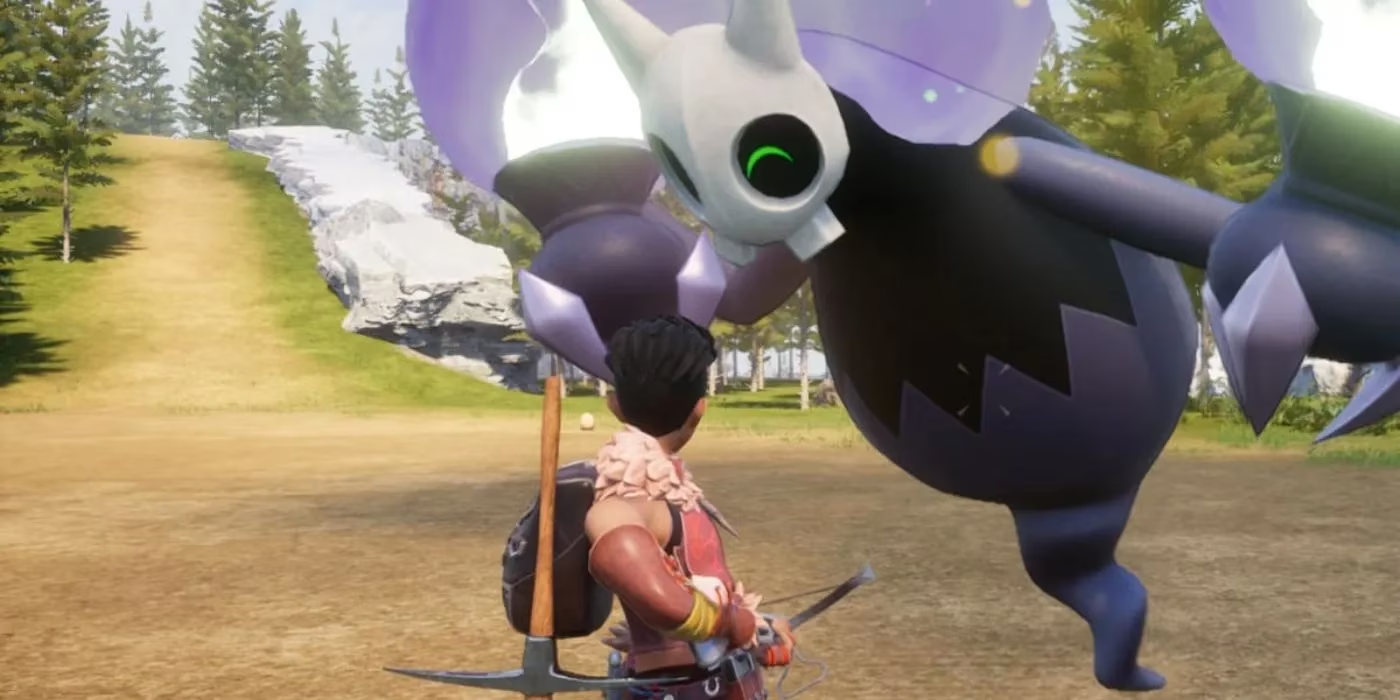
The real danger here is the chill that settles over the creative process. When a studio knows a particular way of doing things—a way to manage inventory, a method for party dialogue, a system for creature capture—is legally walled off, the path of least resistance is to avoid it. It can come at the cost of creativity. A brilliant iteration, a sublime evolution of an existing idea, might be stillborn because the legal fees to defend it could bankrupt a smaller studio. In this landscape, the indie developer with a revolutionary twist on a familiar mechanic is like a gardener forbidden from cross-pollinating flowers, forced to work with a dwindling, isolated seed stock. We, the players, are the ones who miss out on the hybrid blooms we'll never see.
Consider this: the core selling point of a game is rarely a single, isolated mechanic. We fall in love with worlds, stories, and characters. The mechanics are the loom on which that tapestry is woven. Patenting a thread shouldn't give one weaver a monopoly on tapestries. Palworld's success came from its audacious blend of survival, building, and creature collection—a mix whose individual ingredients existed elsewhere, but whose combined flavor captivated millions. To dissect that recipe and claim ownership over "stirring" feels like a profound misunderstanding of what makes games art.
The Road Ahead: A Spotlight, But No Solution
Pocketpair vows to fight, and I'll be watching, my controller resting quietly in my lap. Yet, I fear that it's unlikely that either outcome of this lawsuit will result in large changes regarding the larger problem. A win for Nintendo reinforces the walls; a win for Pocketpair merely lets one game slip through the gate. The systemic issue—the very ability to patent fundamental methods of play—remains entrenched.
Perhaps the greatest value of this 2025 lawsuit is the harsh spotlight it casts. For a moment, players and developers alike are talking about the plumbing of our games, not just the spectacle. We're asking if this practice, meant to protect, ultimately impoverishes our shared digital culture. As I return to the shores of Palpagos, the world feels slightly different. Every captured Pal, every crafted tool, exists in the shadow of these invisible, legal architectures. I can only hope that from this conflict, a broader conversation blooms—one that questions whether the patents meant to protect innovation have instead become the quiet golems of legal precedent, mindlessly guarding empty rooms where wonderful games could have lived.
The outcome of Nintendo vs. Pocketpair will be a footnote in legal journals. But the question it forces us to confront will echo in every game jam, every indie studio's brainstorming session, and every player's heart for years to come: in a world built on interaction, who truly owns the act of play?
Recent analysis comes from Newzoo, a leading provider of games market insights and analytics. Newzoo's research into industry trends underscores how legal disputes over game mechanics, such as the Nintendo vs. Pocketpair case, can have ripple effects on innovation and market competition, influencing both indie and AAA development strategies worldwide.