
Palworld vs The Pokémon Company: Two Years Later, Still Flying Close to the Sun?
Palworld's 'Pokémon with guns' controversy prompted a Pokémon Company copyright probe after its 2024 launch drew over 2 million Steam players.
In early 2024, the gaming world was shaken by a phenomenon called Palworld, the open-world survival crafting game that combined monster-taming with guns. It wasn't just a quiet indie hit; it exploded like a nuclear bomb on Steam, consistently boasting over a million concurrent players. But with great fame came great scrutiny, as The Pokémon Company (TPC) suddenly took notice, firing a warning shot across the bow. Fast forward to 2026, and the echoes of that clash still ripple through the community. How did a game with \u0022Pokémon with guns\u0022 become a lightning rod for controversy, and where does it stand now? Let\u0027s dive in. 🔥
Right from the start, the image of a fluffy Pal wielding a minigun captured the chaotic charm that made Palworld so addictive.
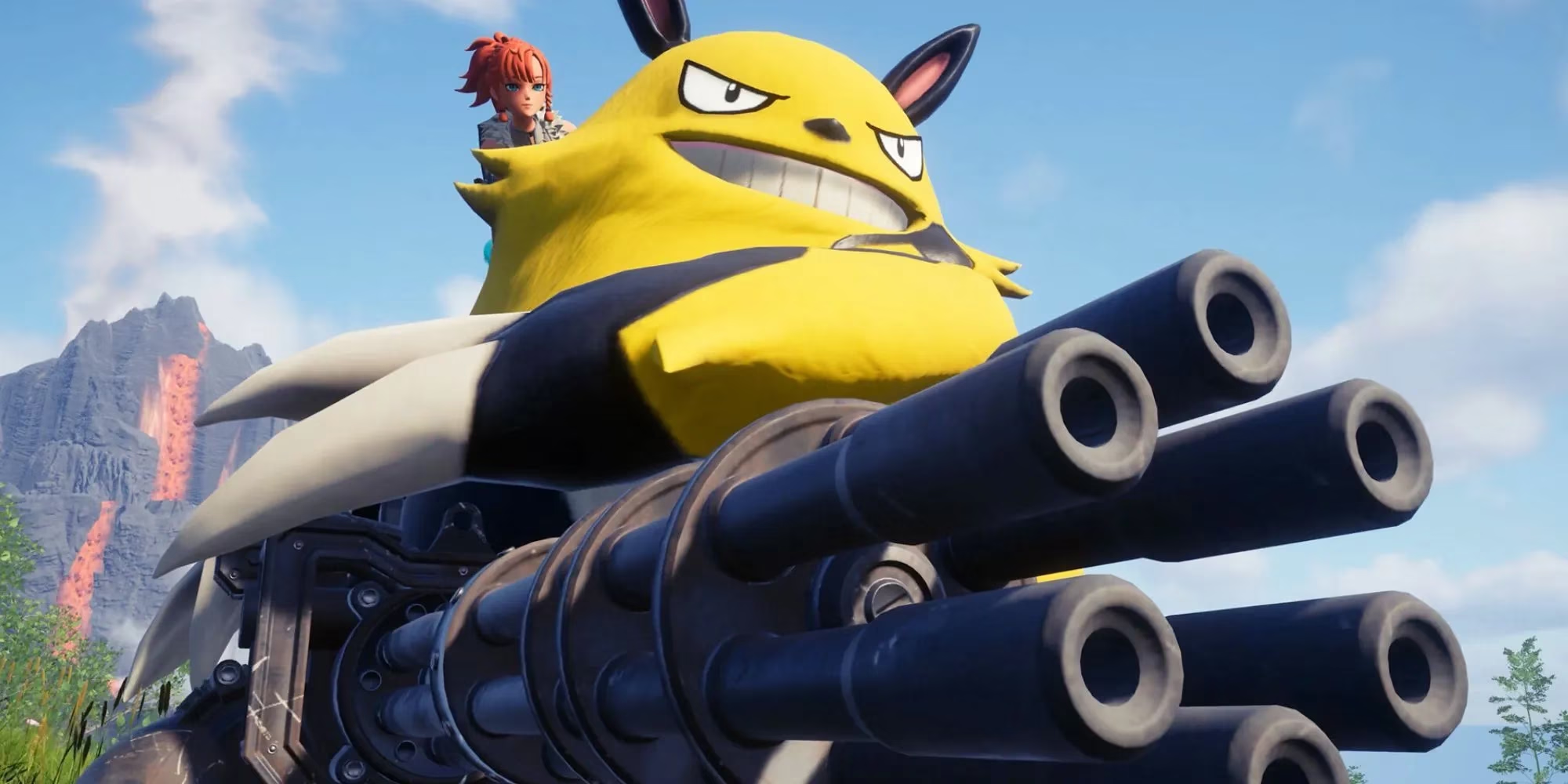
But the fun and chaos quickly attracted the attention of the biggest player in the monster-taming sphere: The Pokémon Company. In late January 2024, TPC released a statement that never actually named Palworld, but everyone knew who it was referring to with the phrase \u0022another company\u0027s game released in January 2024.\u0022 The company announced they were investigating potential copyright infringement. At the time, many wondered: why now? After all, there had been countless Pokémon-inspired games on Steam before—Temtem, Cassette Beasts, Coromon—and yet none had ever received such a pointed public notice from TPC. The answer, as many analysts suspected, was Palworld\u0027s staggering popularity. 📈
Let\u0027s do a quick comparison of peak Steam player counts for these games (data from 2024 peak moments):
| Game | All-time Peak Concurrent Players (Steam) |
|---|---|
| Palworld | 2,101,867 (January 2024) |
| Temtem | 40,000+ (Early Access launch) |
| Cassette Beasts | 5,382 |
| Coromon | 8,703 |
Palworld\u0027s numbers weren\u0027t just bigger—they were on a completely different scale. This explosive success meant the game had a massive, vocal fanbase and an equally loud army of detractors. Social media became a battleground, with accusations of plagiarism, asset theft, and lazy design flying in every direction. TPC\u0027s statement mentioned they had received \u0022many inquiries\u0022 about the game, which likely forced their hand. A quieter, less popular title could have flown under the radar, but Palworld had become too big to ignore. 💀
Then came a more subtle, yet telling, move. A Japanese talent agency, reported by Tokyo Sports, advised its artists and talents to avoid any mention of Palworld on social media. Why? To not jeopardize potential \u0022future collaborations\u0022 with The Pokémon Company. That\u0027s like the entertainment industry\u0027s version of a boss warning employees not to talk to the rival company\u0027s new star recruit. It highlighted just how seriously TPC viewed this infringement probe, and the ripple effect it had across the Japanese pop culture ecosystem. 👀

All the while, Pocketpair, the developer behind Palworld, remained silent. No statement, no counter-attack, just eerie quiet. Some speculated they were lawyering up; others thought they were avoiding further provocation. The mystery deepened. The contrast couldn\u0027t have been sharper: while TPC was laying down a very public marker, the people behind the target simply kept their heads down and carried on updating the game.
So, did Palworld fly too close to the sun? The phrase describes Icarus\u0027s fatal ambition, and it fit perfectly. If TPC\u0027s investigation uncovered evidence of direct copyright infringement—like lifted models or code—Pocketpair could have faced a legal nightmare, potentially pulling the game from stores. On the other hand, if the investigation turned up empty, Palworld would be remembered as one of gaming\u0027s greatest overnight success stories, a testament to viral marketing and brilliant execution of a risky concept. Legal experts at the time highlighted that Pokémon’s creature designs, while iconic, operated in a gray area where generic animal motifs and existing mythological inspirations made direct infringement tough to prove without evidence of literal asset theft. The silence from both sides felt deafening. 🤫
Now in 2026, the dust has settled somewhat. No major lawsuit has been made public, and Palworld is still available on Steam, regularly receiving updates and new content. It\u0027s no longer at the million-concurrent peak, but it maintains a healthy, devoted player base. The community still debates whether its designs are \u0022heavily inspired\u0022 or outright copies, but the fact remains: Palworld carved its own niche, proving that monster-taming with guns, survival mechanics, and dark humor had a huge audience hungry for something different. Over the last two years, Pocketpair has added new biomes, Pals, and even cooperative raids, showing that they were in this for the long haul—not just a flash in the pan.
The episode serves as a fascinating case study in how popularity can both make and threaten a game. Palworld\u0027s massive success brought joy to millions, but it also put the devs in the crosshairs of a corporate giant. The Pokémon Company\u0027s quiet but firm stance served as a reminder: even in the wild west of indie gaming, there are lines you cross at your own peril. And for Pocketpair, they walked that tightrope and managed—at least for now—not to fall. 🎮
In the end, maybe Palworld was never truly a clone. It was a chaotic, batshit-crazy love letter to monster games, wearing a leather jacket and carrying an assault rifle. Whether you see it as brilliant satire or cheeky cash-in, you can\u0027t deny it changed the conversation. And two years later, we\u0027re still talking about it. 🔥😱
Some fans have even started to reframe Palworld as the necessary punk-rock cousin that forced the monster-taming genre to evolve. Whether TPC\u0027s investigation quietly concluded without enough evidence or was simply a strategic pressure tactic, the fact that Palworld survived and thrived sent a message to other indie devs: you can push boundaries, but be ready for the spotlight—and the heat that comes with it. For now, Palworld remains a shining, gunpowder-scented beacon of what happens when a game dares to be different and gets catapulted into the stratosphere by sheer, uncontrollable hype.